Introduction
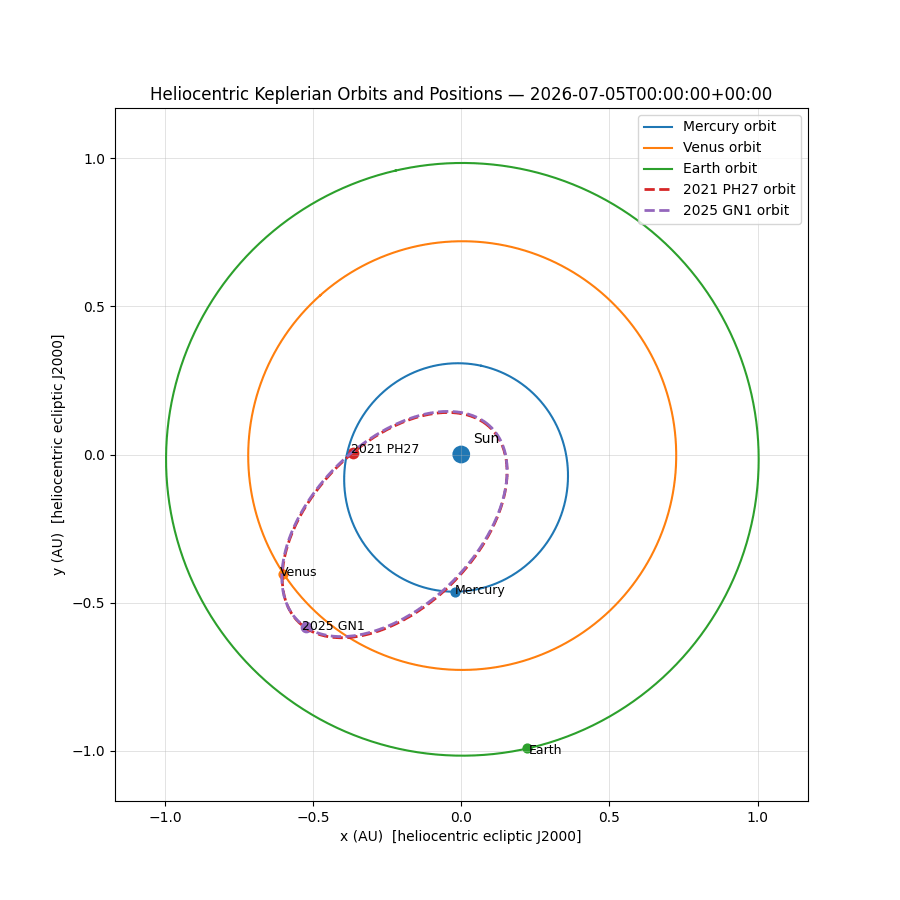
In the Solar System, within Earth’s orbit, there are two recently discovered asteroids belonging to the Atira class, which orbit the Sun in very similar orbits: the pair 2021 PH27 and 2025 GN1. The combined analysis of orbital parameters, taxonomic classification, and numerical simulations of orbital evolution up to 100,000 years ago indicates that the two bodies most likely share a common origin. Available data suggest a likely formation scenario in which a progenitor asteroid with a rubble-pile structure, after a rotational split due to the YORP effect, forms a binary system that subsequently disintegrates, giving rise to the pair [1, 2, 3].
The interesting thing is that the orbit of the pair 2021 PH27 – 2025 GN1 has a minimum orbit intersection distance of about 2 million km from that of Venus, which is 6.5 times the Earth-Moon distance. Considering that the rotational fission of an asteroid ejects even small fragments into space, it is possible that, along the common orbit of the pair, there is a stream of meteoroids capable of generating meteors or even fireballs in the Venusian atmosphere. This is a very similar scenario to that of the asteroid pair (3200) Phaethon – 2005 UD, which are the parent bodies of the Geminid meteor shower on Earth. In the case of Phaethon, we are dealing with an active asteroid, and the Geminid meteoroids are emitted from the asteroid’s surface during perihelion passage, probably by thermal fracturing or by sublimation of volatile material, while we do not yet know whether 2021 PH27 is active or not; the geometry, however, is the same. For this reason, 2021 PH27 could be considered the “Phaethon of Venus“.
The next opportunity to try to detect very bright fireballs in the atmosphere of Venus due to 2021 PH27 and 2025 GN1 will occur on July 5, 2026, when the planet will be at its closest approach to the pair’s orbit and, at the same time, will reveal part of its shadowed hemisphere to Earth. In this article, we’ll briefly explore the guidelines for trying to detect fireballs in the atmosphere of Venus: an extremely rare and difficult event to image, requiring an appropriately sized telescope.
Meteors and Airbursts in the Atmosphere of Venus
When our planet passes through a meteoroid stream, we observe—from the ground or from space—a shower or, if the stream is particularly intense. The same phenomenon can occur on other planets with atmospheres, including Venus. However, a question arises: given that Venus’s atmosphere is so opaque, preventing direct observation of its surface in optical light, would meteors be visible from space? Let’s try to answer this question, taking into account the planet’s characteristics. Venus orbits at an average distance of 0.723 AU from the Sun, with an orbital period of 224.7 days and an eccentricity of 0.007. The planet is comparable to Earth: its mean equatorial radius is 6,052 km, while its mass is 0.815 times that of Earth. The gravitational acceleration at the surface is 8.8 m/s² (90% of Earth’s). Its escape velocity is also similar: 10.4 km/s, sufficient to maintain a fairly dense atmosphere. With these data, on Venus, the planetocentric velocities of interplanetary meteoroids belonging to the Solar System are between 10.4 and 85 km/s, not significantly different from the Earth’s range of 11.4 and 72 km/s; in fact, they are slightly higher, precisely because Venus is closer to the Sun than Earth and smaller bodies at Venus’ altitude move, on average, at a higher speed. Therefore, the speeds of meteoroids in Venus’s atmosphere are certainly sufficient to generate meteors.
The clouds enveloping Venus are located between 45 and 70 km above the surface, while thin hazes are found between 70 and 90 km. On Venus, the atmospheric pressure at ground level is approximately 92 times that of Earth, and carbon dioxide (CO2) is its main component, which is also responsible for an intense “greenhouse effect” that raises the atmospheric temperature at ground level to an average of 730 K. To determine whether meteors are visible from space, one can identify the altitudes on Venus that have the same atmospheric density as the altitudes at which meteors on Earth reaches its maximum brightness. Considering realistic models (i.e., profiles measured by spacecraft) of the Venusian atmosphere, we observe that the range of maximum meteor brightness on Earth, 100-70 km, corresponds to that of 120-100 km on Venus [4]. This result indicates that, for the same meteoroid mass and velocity, meteors on Venus are generated at a much higher altitude than on Earth, well above the upper limit of clouds and haze, making it possible to observe Venusian meteors from space. These considerations also apply to metric-sized bodies, which give rise to the brightest fireballs and the resulting final airburst, due to the fact that the pressure of the shock wave exceeds the cohesive force of the meteoroid [5].
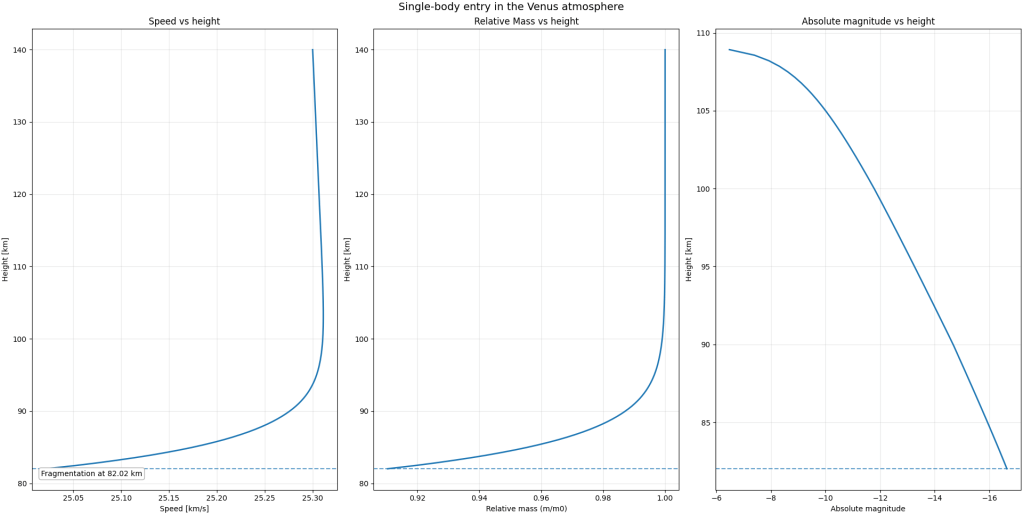
From data from US military satellites, we know that, on average, every two weeks, a meteoroid of about 1 meter in diameter disintegrates in Earth’s atmosphere, causing the site to experience an intense airburst. Airbursts on Earth mostly occur at altitudes between 20 and 40 km above the ground. On Venus, adopting a realistic atmospheric model such as the Venus International Reference Atmosphere (VIRA) and using the equations describing the ablation and braking of a one-meter diameter meteoroid with a planetocentric speed of 25.3 km/s (that of the meteoroids from PH27-GN1), an average density of 3000 kg/m³, a luminous efficiency of 3%, and a cohesive force of 5 million pascals (typical values for small meteoroids), we find that the bolide phase, lasting about 3 seconds, occurs between 110 and 82 km, always above the cloud layers, with an absolute magnitude, at maximum brightness, of almost -17. In this case, the airburst occurs at an altitude of 82 km above the ground and is typically brighter than the fireball phase, because it increases the exposed surface of the meteoroid capable of emitting radiation. More massive meteoroids can give rise to brighter fireballs; for example, a small asteroid 5 meters in diameter, under the same conditions as before, can generate a fireball of absolute magnitude -20, while a 20-meter-diameter asteroid reaches -23. More generally, under the same initial conditions, the absolute magnitude of the fireball at maximum brightness, before disintegration, is directly proportional to the logarithm of its mass [5].
Finally, it is believed that meteoroids in a data stream can be observed as meteors if the minimum distance from the orbit of the planet with which they interact falls below 0.1 au, and this empirical criterion is fully satisfied by the orbit of the PH27-GN1 pair. In conclusion, it is theoretically possible to observe both meteors and fireballs with airbursts from space in the atmosphere of Venus, including those likely associated with PH27 and GN1. Confirming this hypothesis, however, requires dedicated observations.
When to observe possible PH27-GN1-related airbursts
The next favorable date for ground-based observation of fireballs belonging to the hypothetical PH27-GN1 stream is July 5, 2026, when Venus will be at its closest approach to the pair. On this date, the Sun will set around 19:00 UTC for Italy, when Venus will be 23° above the horizon, with an apparent diameter of 16.7 arc seconds and a 67.3% illuminated phase: approximately 33% of Venus’s hemisphere will be invisible because it is not illuminated by the Sun. It is precisely this shadowed portion of Venus’s disk that will be worth keeping an eye on: potential meteoroids associated with PH27 – GN1 will also impact the planet’s nighttime atmosphere, visible from Earth, and therefore it will be possible to detect airbursts in Venus’s atmosphere using the same techniques used for Jupiter and Saturn: recording high-resolution video and looking for a bright flash in the shadowed portion of the planet. The observation window will not be very wide, but it will be possible to try to detect Venusian impacts from 3 days before to 3 days after July 5th.
The PH27-GN1 shower seen from Venus – if it exists – could have a ZHR at least comparable to that of the Orionids here on Earth (about 30 meteors per hour), but only the most intense fireballs, associated with metric-sized meteoroids, will be visible. Given the distance between the two planets, which on July 5th is 1.01 au, the fireballs in Venus’ atmosphere seen from Earth are about 31 magnitudes fainter; one can therefore hope to detect fireballs of absolute magnitude -15/-17 that become apparent magnitude +16/+14. These are very delicate observations that are best carried out in pairs with two large-diameter telescopes (say 30-50 cm or more), placed in different locations to eliminate any false positives, and with long focal lengths to have only the planet in the field of view – in short, the typical instrumental setup used for high-resolution planetary imaging. For observations, a CMOS black-and-white camera can be used in video mode with an exposure time of 0.1-1 s without filters to collect the maximum amount of light. Unfortunately, significant interference will come from the planet’s illuminated side, which is very bright and could be annoying for observations. To partially overcome this problem, filters that pass near-infrared light (such as the classic IR-pass at 685, 742, or 807 nm) can be used to observe at wavelengths where the fireball emits most strongly, reducing light from the illuminated hemisphere of Venus. Since we are not interested in imaging the IR emission from Venus, imaging with an IR-pass filter can be done when the Sun is still slightly above the horizon, thus increasing the observing window and avoiding the more turbulent layers of the Earth’s atmosphere. Another method to hide the illuminated side is to use a coronograph, but it is more complex to set up.
Clearly, this type of observation cannot be improvised, so the equipment must be prepared and tested in the previous days, imaging stars of known apparent magnitude with the same focal length and exposure as will be used for Venus, to ensure that objects up to at least +14/+16 can be imaged. The probability of detecting significant fireballs in Venus’ atmosphere is very low, but their detection would constitute important evidence to confirm the recent history of PH27 and GN1. If you think you have detected fireballs in the night atmosphere of Venus, please contact me.
Bibliography
[1] Carbognani Albino, Tanga Paolo, Bernardi Fabrizio, “Is 2021 PH27 an active asteroid with a meteor shower detectable on Venus?”, Monthly Notices of the Royal Astronomical Society: Letters, Volume 511, Issue 1, pp.L40-L44, 2022.
[2] Albino Carbognani, Marco Fenucci, Toni Santana-Ros, Clara E. Martínez-Vázquez, Marco Micheli, “Investigation of the dynamics and origin of the NEA pair 2021 PH27 and 2025 GN1”, Icarus, Volume 449, 2026.
[3] Pravec P. et al., “Formation of asteroid pairs by rotational fission“, Nature volume 466, pages 1085–1088, 2010.
[4] Apostolos A. Christou, “Prospects for meteor shower activity in the venusian atmosphere”, Icarus, Volume 168, 2004.
[5] Beech Martin, Brown Peter, “On the Visibility of Bright Venusian Fireballs from Earth”, Earth, Moon, and Planets, Volume 68, 1995.
 Asteroidi e dintorni